Huang was the chip industry’s biggest advocate for China sales. Where does US-China tech policy go from here?

By Clare Duffy
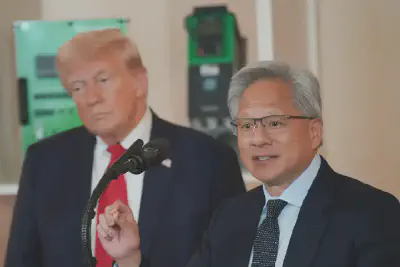
Jensen Huang’s exit from Nvidia amid swirling national security concerns surrounding his reported extramarital relationships, including with a woman US officials suspect to be a Chinese spy, could lead to a shake-up of the United States’ stance on trade and tech policy related to China.
Huang was one of President Donald Trump’s closest advisors on AI policy. He’s been a staunch advocate for fewer restrictions on sales of advanced US chips globally, including to China, arguing that making US technology the standard around the world is good for American competitiveness and security.
Opponents of that view argue that selling advanced chips to China could propel the country’s efforts to train advanced AI models that could ultimately harm the United States — a position some Democratic lawmakers are now pushing even harder in the wake of the Huang scandal.
The situation also likely takes off the table the possibility that Trump could float eased restrictions on chip sales in exchange for other concessions when he is set to meet with Chinese President Xi Jinping at the Asia-Pacific Economic Cooperation (APEC) Summit later this month, said David Bader, professor at the New Jersey Institute of Technology.
And it could lead to additional restrictions on chip sales to China, either from Congress or the White House.
“I think it’s very likely that we see more crackdowns on chip sales to China for no other reason than, right now, I think that everyone involved from the U.S. government side is looking for a way to demonstrate that they are taking their job seriously, given all of the reporting about potential compromises or potential corruption or potential sidestepping of investigations,” said Heather West, geotechnology practice head at Eurasia Group.
That could hurt business for Nvidia and other US chipmakers.
And Huang wasn’t the only one arguing that selling chips to China, and making US technology the standard around the world, would ultimately benefit American security. China has repeatedly found ways around US restrictions, Bader said, and such a policy “lights a fire under them to create their own domestic technologies” that could ultimately compete with American tech around the world.
Still, West said the situation is unlikely to completely disrupt the current state of the US-China trade relationship. “Both Trump and Xi are very dedicated to maintaining stability,” she said.

David A. Bader
Distinguished Professor, Associate Dean for Research, and Director of the Institute for Data Science
David A. Bader is a Distinguished Professor in the Department of Data Science and Associate Dean for Research in the Ying Wu College of Computing at New Jersey Institute of Technology.