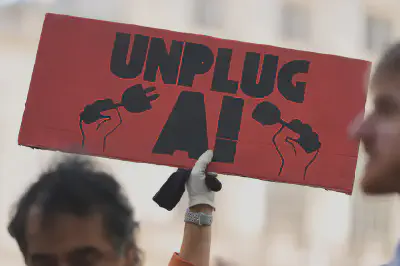
N.J. embraced AI. Flock cameras, deepfakes and Big Tech distrust have leaders wrestling with limits.

By Jelani Gibson | NJ.com
Across the country, states are racing to write the rules for artificial intelligence (AI). New Jersey enters that fight with a complication of its own: It has spent years racing just as hard to embrace AI.
Former Gov. Phil Murphy enthusiastically promoted that vision, describing New Jersey’s pursuit of the technology as an “AI Moonshot.”
Under Gov. Mikie Sherrill, the state’s relationship with artificial intelligence has become considerably more complicated, with investment and guardrails becoming two sides of the same coin.
Now the state is confronting a harder question: What happens when the technology it raced to embrace starts reshaping jobs, policing, privacy and everyday life?
What began as an economic development campaign to make New Jersey a destination for artificial intelligence has grown into debates over what police can do with someone’s face, how companies can use technology to monitor workers, what protections children need from AI-generated material, how much electricity massive data centers should consume and who should bear those costs.
Yet none of that has stopped New Jersey from making more bets on the technology.

In October, the state announced a $125 million public-private supercomputer initiative backed by a $75 million donation from Nvidia co-founder Chris Malachowsky. The Sherrill administration said the partnership would cover everything from detecting cancer to modeling coastal flooding on the Jersey Shore. Meanwhile, lawmakers in Trenton held hearings on how to restrict some of the technologies AI has helped accelerate.
As evidence of the guardrails it has embraced, the administration pointed to laws Sherrill signed restricting surveillance pricing and algorithmic rent-setting, along with protections aimed at the effects of social media on children.
“Governor Sherrill and her Administration are committed to ensuring AI develops with strong safeguards against its risks, while ensuring our communities share in its benefits,” the administration said in a statement.
Nowhere is tension more evident than in the Assembly. Its members face reelection every two years, leaving them less breathing room from the political issues of the moment.
Facial recognition divides lawmakers
Last month, multiple committees held back-to-back hearings on AI. Most of the bills were up for discussion only, meaning lawmakers took testimony but did not vote.
During an Assembly Public Safety and Preparedness Committee hearing, lawmakers wrestled with two bills. A5423 would prohibit facial recognition from being used as the sole basis for a warrant. A5483 would restrict automated license plate readers and shorten how long their data could be stored.
Dillon Reisman, an ACLU of New Jersey staff attorney who focuses on technology, raised concerns about civil rights and due process during the hearing.
“Misidentification is not the exception when it comes to facial recognition tools, but the norm,” Reisman said. “By their very nature facial recognition systems used in law enforcement context do not and cannot guarantee an exact match.”

Reisman pointed lawmakers to the case of Nijeer Parks, a Black man who was jailed for 10 days after facial recognition technology misidentified him.
Assemblyman Paul Kanitra, R-Ocean, pushed back on the suggestion that the potential for mistakes justified significantly limiting the technology.
“We don’t want anyone getting arrested wrongfully but we also don’t want criminals to also have one of the most major tools that law enforcement could use to catch them taken away,” Kanitra said.
Kanitra argued the technology could continue to improve and questioned whether the possibility of bias in the technology was any different from that exhibited by a more human-driven process.
Reisman and other advocates disagreed.
Their concern was not merely that facial recognition could produce a false result. They argued that automation could allow mistakes to occur at a scale difficult to achieve when investigations required considerably more human labor.
Reisman also argued that facial recognition systems can return potential candidates even when the underlying information is insufficient.
“Once a facial recognition system is produced, the existence of those candidates contains the rest of an investigation,” Reisman said.
Assemblyman Joe Danielsen, D-Somerset, chairman of the Assembly Public Safety and Preparedness Committee and sponsor of the facial recognition proposal, continued to support restrictions on the technology. The bill was passed out of committee 5-2 with Democrats voting for it and Republicans voting against.
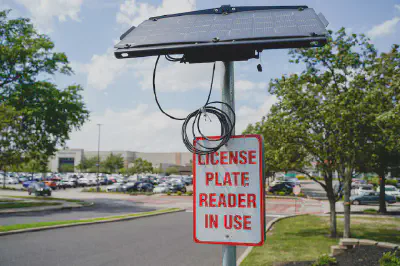
The ideological lines blurred when the committee turned to license plate readers.
Kanitra, after tense exchanges with Reisman over facial recognition, struck a more cautious tone, raising concerns about towns locked into camera contracts that are difficult to exit.
The two debates illustrated a problem confronting lawmakers as increasingly sophisticated technologies migrate from Silicon Valley into local police departments: Rules written around one technology or one potential abuse can quickly get complicated once lawmakers confront how those systems are already being used on the ground.
Sherrill’s administration, meanwhile, said restrictions on law enforcement technology were compatible with its broader embrace of innovation.
“Governor Sherrill is committed to keeping all New Jerseyans safe, and this includes ironclad guardrails on any technology used by law enforcement,” the administration said.
Lawmakers press Meta
The same tension surfaced in another Assembly hearing examining AI’s broader reach.
The Assembly Science, Innovation and Technology Committee heard testimony on legislation addressing the unauthorized use of someone’s identity, disclosure of certain AI-generated material and harmful activity by generative AI platforms and powerful frontier AI models.
“In the absence of federal guardrails, we must ensure the rapid deployment of AI doesn’t outpace our responsibility to protect New Jersey residents,” Assemblyman Chris Tully, D-Bergen, the committee chairman, said.
Assemblyman Andrew Macurdy, D-Union, said the technology was a double-edged sword.
“AI could bring enormous societal benefits, but also the potential for catastrophic risks,” Macurdy said.
Lawmakers also heard from one of the companies the emerging rules would affect.
Matthew Lenz, Meta’s public policy director, said the company was committed to making artificial intelligence widely available while attempting to do so safely.
“People will only embrace AI if they have the confidence it works in alignment with their intentions,” Lenz said. “And that confidence has to be earned through rigorous safety and transparency.”
Lenz said making models more open to public inspection could increase safety and trust.
“When people can examine a model, more vulnerabilities get found and patched,” he said.
Lawmakers put those assurances to the test. Several pressed Lenz about a voluntary White House agreement with AI companies — Anthropic, Meta and Nvidia among them — and asked whether there was any enforcement mechanism if a company broke its commitments.
“No, I don’t believe so,” Lenz replied, adding that he would follow up with the committee.
‘AI is physical’
David Bader came to the debate from a different direction.
Bader, a professor of data science at the New Jersey Institute of Technology, who served on the Murphy administration’s AI task force, said guardrails were necessary but not a complete retreat.
“What I don’t accept is that the answer is to stop,” he said.
But Bader was equally skeptical of leaving the evaluation of powerful AI systems entirely to their developers.
“If the only people able to evaluate frontier models are the people selling them, we get theology instead of engineering,” Bader said.
“My test for a real risk is whether you can name the mechanism, the failure path and the mitigation,” he added. “An aerospace engineer can tell you exactly how a turbine fails and what the inspection interval is. Most extinction talk fails that test. It’s a mood, not a mechanism.”
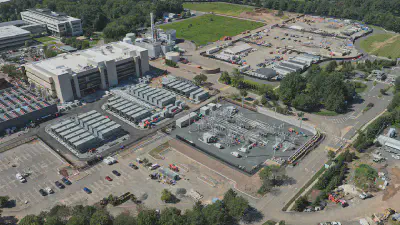
Bader also brought the debate much closer to New Jerseyans’ wallets: electricity.
“Today, the hard part is plugging it in,” he said. “AI is physical.”
The constraints facing frontier AI, Bader told lawmakers, increasingly include electricity and the physical infrastructure required to deliver it, including transformers, substations and connections to the grid.
“And we’re already power limited,” Bader said.
The issue has already prompted action from Sherrill, who signed legislation in July creating a separate ratepayer class for large data centers and requiring that they pay for their own electricity.
Voters wary of Big Tech
Yet a new poll suggests New Jerseyans’ opposition to data centers is driven less by electricity prices than by broader distrust of Big Tech and AI itself.
A Fairleigh Dickinson University poll released in late October found 65% of registered New Jersey voters opposed making it easier to build data centers in the state, compared with 25% who wanted it to be easier.
Researchers then tested what might be driving that opposition.
Simply prompting voters to think about electricity prices did not produce a statistically significant change in support for data centers, according to the poll. But among respondents prompted to think about regulation of Big Tech companies, those who favored greater regulation were 12 percentage points less likely to support making data centers easier to build, dropping from 26% to 14%.
AI produced a similar effect. Among respondents prompted to consider AI regulation, support for making it easier to build data centers dropped from 23% to 14% among those who favored more regulation.
“Data centers think that they can mute opposition by building their own power plants, but the data is showing that won’t be enough, and distrust of big tech companies is a much more important barrier,” said FDU Poll director Dan Cassino.
At both hearings, lawmakers confronted what happens when a technological revolution reaches a resident’s paycheck, face, neighborhood, police department or electric bill. And while none claimed to have all the answers, some, like Macurdy, described finding them as a defining challenge of their generation.
“Sensible protections around AI development is the public policy question of our time,” Macurdy said. “What we do in the coming months and years will help determine the world our children and grandchildren inherit.”

David A. Bader
Distinguished Professor, Associate Dean for Research, and Director of the Institute for Data Science
David A. Bader is a Distinguished Professor in the Department of Data Science and Associate Dean for Research in the Ying Wu College of Computing at New Jersey Institute of Technology.