Hey Grok, Is Elon Giving Up on A.I.?
A surprising deal with Anthropic is raising questions about whether Musk’s xAI is abandoning the frontier model arms race to focus on neocloud services instead—including launching G.P.U.s into space.

By Ian Krietzberg
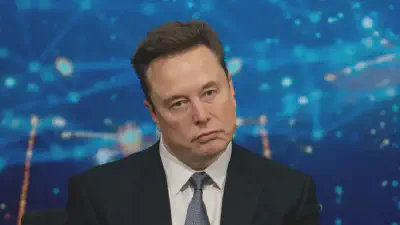
Last week, Elon Musk threw the tech industry for a loop when he revealed that SpaceX, which recently acquired xAI, had cut a deal worth as much as $4 million in annual revenue to lease Anthropic the entire capacity of its Colossus 1 data center. Not three months earlier, Musk had called Anthropic, an A.I. archrival, “evil.” Now it appears he’s becoming their data landlord.
The deal makes plenty of sense for Anthropic: Access to Colossus will, in their words, “substantially increase our compute capacity.” Recently, Anthropic had been struggling to keep pace with massive, unprecedented demand for Claude Code and its Opus models—as has become evident in the form of ever-tightening usage restrictions and higher prices. As soon as it announced the partnership, Anthropic immediately loosened the rate limits on its products.
What the deal means for SpaceX, however, is less clear. More revenue, certainly, as the company prepares for an I.P.O. But it also suggests that xAI—which, until recently, was attempting to compete with Anthropic and OpenAI—may be waving the white flag in the extremely costly frontier model arms race. Musk’s chatbot, Grok, has lagged far behind its rivals in usage and popularity. But xAI does have a ton of compute, having built two Colossus data centers. So why not lease what he doesn’t need, essentially transforming SpaceX into a partial neocloud?
In truth, it seems to be more of an A.I. pivot than a surrender. “I wouldn’t call it a stepping back,” said Tejas Dessai, the director of thematic research at Global X. “I would call it doubling down on what is working for them.” In other words, the model race will be hard to win, he said, and “infrastructure is a good business for SpaceX.” Anthropic also expressed interest in collaborating with Musk to develop data centers in space as part of the partnership—a notion that, despite formidable cooling challenges, began to grow in popularity last year. This last deal point, in particular, would have been music to Elon’s ears. When he folded xAI into SpaceX earlier this year, he specifically referenced the economic opportunity surrounding orbital data centers.
The financial upside could be sizable. Gil Luria, an analyst at D.A. Davidson, told me the deal would help SpaceX materially “shore up” its financials ahead of its I.P.O. journey. Ark Invest founder Cathie Wood, the controversial investment manager and longtime Musk booster, predicted that the agreement would allow SpaceX to pivot “from massive losses at Colossus to significant profitability as a neocloud on an estimated $5-6+ billion in annual revenues.” They’re not alone in that thesis: The Wall Street Journal reported on Tuesday that Google is in talks with SpaceX to secure a rocket-launch deal to send its own early-stage orbital data centers into space. And in March, Blue Origin filed for F.C.C. permission to launch Project Sunrise, a satellite constellation designed to do advanced computation.
Of course, Elon’s pivot also raises questions about the future of Grok, and whether xAI is meaningfully diverting from its foundational mission. As the Journal reported this week, downloads of Grok have fallen by more than 50 percent from their peak of 20 million in January—the month Grok gave users the ability to digitally undress people. Since then, the app has tumbled down various app store rankings, far behind ChatGPT and Claude. Indeed, a recent survey of 260,000 Americans found that only 0.174 percent pay for Grok while 6 percent pay for ChatGPT—suggesting that all those “hey @grok” prompts on X are more of a gimmick than a real business.
The New Normal
When Musk launched xAI in 2023, his stated reasoning was fairly straightforward: The notion of “pressing pause” on the A.I. race—a trendy conversation among safety advocates at the time—didn’t “seem realistic” to him, so he might as well be the one to win it. He stressed the need to “create a third option” to rival OpenAI and Google—a “maximally truth-seeking” alternative to the products coming out of the other frontier labs, which he deemed too “woke.” A few months later, Musk would sue OpenAI, accusing co-founders Sam Altman and Greg Brockman of conspiring to steal the nonprofit entity that Musk had initially funded to the tune of millions. (Musk, as I wrote last week, is fighting for $134 billion in damages, the removal of Altman from the OpenAI board of directors, and the return of the company to its original nonprofit structure… none of which is likely to happen.)
While Musk was “late” to the chatbot game, as he acknowledged, he quickly closed the delta between xAI and OpenAI, primarily by raising the kind of funds accessible to the world’s richest man: two $6 billion rounds, a Series B and C, in 2024, plus a $20 billion Series E in January, followed by a merger with SpaceX, another of his companies. Meanwhile, he set about constructing the world’s largest supercomputer in Memphis—a data center loaded with hundreds of thousands of G.P.U.s that he christened Colossus. Incredibly, Musk brought the facility online in just 122 days (thanks in part to dozens of gas turbines, which haven’t been popular with the local community). More recently, xAI stood up a second data center, Colossus 2, bringing its combined G.P.U. count to well above a million.
Now, having fallen behind other frontier models, all that extra compute is presumably looking too good to waste on Grok. “The race to model development might already be over,” Dessai said. “The real business that still has plenty of opportunity is the infrastructure layer of that story.” For Musk, he said, this might well be a step away from the kind of model business currently powering OpenAI and Anthropic, and a step toward other kinds of non-chatbot applications, such as geospatial imagery, data analytics, self-driving, and robotics. There’s “a broad range of applications they could go into,” he said. “The deal is another reminder that the A.I. race is not just about models,” agreed Jennifer Pruitt, a portfolio manager at Liberty Street, which is invested in SpaceX. “It is also about compute, power, infrastructure, distribution, and the ability to execute at scale.”
Hanging over this constant jockeying for frontier dominance is the simple fact that the business models “are still insufficient to support the A.I. models we have today,” David Bader, a distinguished professor of computing at New Jersey Institute of Technology, told me. As a result, he expects collaborations like the one between Anthropic and SpaceX to become “the norm”—sort of like how the streaming wars ended with companies tearing down their walled gardens and rebranding as suppliers or platforms. “There will be a consolidation, and these companies will need to support each other and really look at the efficiency of the cost for operating data centers, both for training and inference,” he said. “And in doing so, they will have to work together.”

David A. Bader
Distinguished Professor, Associate Dean for Research, and Director of the Institute for Data Science
David A. Bader is a Distinguished Professor in the Department of Data Science and Associate Dean for Research in the Ying Wu College of Computing at New Jersey Institute of Technology.