Goldman, JPMorgan Show Wall Street’s Split in Quantum Computing Race
As a breakthrough proves elusive in the quest to deploy the nascent technology and boost earnings, global finance is divided on how to proceed.

By Isabella Ward and William Shaw

Roughly three years ago, Goldman Sachs Group Inc. looked like it had an edge in Wall Street’s race to master quantum computing.
The banking giant had assembled a handful of highly specialized scientists and partnered with Amazon.com to figure out how the nascent technology could be used to juice better returns for its raft of wealthy clients. They were shocked by what they found.
Goldman’s researchers discovered they would have to run an algorithm for millions of years in order to solve the problem. What’s more, the processor would need to have at least 8 million so-called logical qubits — a set of quantum bits that form the building blocks of quantum computers. Current machines consist of fewer than 100.
Shortly after, Goldman’s quantum team evaporated amid the bank’s widespread cost cutting program. While it now employs next to none, its rival JPMorgan Chase & Co., on the other hand, has persisted with a team of well over 50 physicists, computer scientists and mathematicians, exploring applications in optimization problems, machine learning and cryptography.
The contrast between the two of the world’s largest lenders is emblematic of the split among global financial firms debating ways to harness what’s touted to be the next big thing after artificial intelligence. Experts say quantum computing can reshape areas ranging from new drug discovery to machine learning and risk modeling in finance, with the potential to add billions of dollars in revenue. But it’s also thought to be still years away from offering many practical solutions, raising questions about its near-term value.
Unlike pharmaceutical, defense or material sciences firms — which appear to have a clearer understanding of where they would like to use quantum computing — banks, insurers and asset managers are chasing fixes to a myriad of complex problems: transaction fraud, risk management, how to maximize returns from a portfolio and asset price prediction, to name just a few. The wide array of issues they want to tackle and the limitations imposed by currently available hardware have made it more difficult for them to pinpoint potential benefits.
Wary of these challenges, many financial firms have largely stayed on the sidelines, happy to let others take the lead in exploring these machines that are exponentially more powerful than existing supercomputers. But some like JPMorgan are pouring resources in the hope that one day the technology would give them an edge over competitors.
“We’re positioning ourselves so we can take advantage by understanding what the problem space is across our portfolio,” said Rob Otter, JPMorgan’s head of global technology applied research who earlier ran State Street Corp.’s digital technology department, including quantum research.
While JPMorgan declined to reveal the exact size of the team, Otter said his crew is seeking ways to resolve performance issues and bottlenecks using a quantum computer across the business — including the investment bank — working with colleagues covering portfolio analytics, asset and mortgage pricing.

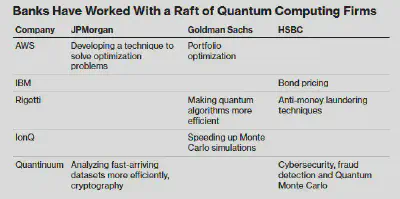
n November, the bank said it had developed a method to process and analyze large, fast-arriving datasets more efficiently using Quantinuum Ltd.’s Helios processor, which would enable the bank to perform complex tasks like anomaly detection, fraud monitoring, or network analysis quicker. In March last year, it demonstrated an algorithm on a quantum processor with Amazon.com that could make portfolio selection easier by identifying large sets of uncorrelated assets, enhancing diversification and risk management.
Otter said his team may be able to start running useful algorithms on a quantum processing unit in the next couple of years. Now, “we’re waiting for the hardware to be more commercially viable in order to use them,” he said.
Still largely in the domain of academic research, the technology is based on the complex principles underpinning quantum mechanics. Just like traditional computers, quantum computers also use tiny circuits to perform calculations, but they do that simultaneously, rather than in sequence. That allows for complex problems to be solved at vastly faster speeds than those of classical processors.
Business consultants even have some early estimates for its potential. Research by McKinsey & Co. last year said revenue from quantum computing is likely to surge to as much as $72 billion by 2035, from about $4 billion in 2024, fueled by developments in industries such as chemicals, life sciences and finance.
Given the stakes, others in the world of finance — besides JPMorgan and Goldman — have been poking around as well, but with varying intensity.
UBS Group AG is upskilling around 50 of their quant analysts in the basics of quantum computing. Spanish lender BBVA SA has worked with Multiverse Computing SL on speeding up ways to optimize portfolio management, and also with other firms. Credit Agricole SA has looked at how quantum algorithms can anticipate credit downgrades better. Many lenders are also racing to upgrade their cryptography, wary that the immense power of the emerging technology may enable it to break encryption standards.
But most of the action is currently led by tech titans including Alphabet Inc.’s Google and International Business Machines Corp., plus a raft of startups, as they build and test software and hardware, like Google’s Willow and IBM’s Heron processors. Though current models are too small and unreliable to be useful, they have been collaborating with companies across industries to explore potential applications by offering their services on the cloud.

For instance, BMW is working with Nvidia Corp. and quantum software firm Classiq to find ways to improve drivetrains and cooling systems; Novo Nordisk A/S and Roche Holding AG are looking at modeling molecular interactions for new discoveries; and, Exxon Mobil Corp. is working with IBM to map the most efficient routes for its tanker fleets.
But for financial firms, developing solutions for risk tolerance and portfolio diversification gets trickier.
Plus, when it comes to applications for finance, “there’s a lot of confusion” about the direction, further complicated by differences in system architectures and technologies used to build them, said Subodh Kulkarni, chief executive of quantum computer builders Rigetti Computing Inc. — one of a growing number of listed companies in this area. That could mean one bank may have to work with multiple quantum computing companies to meet its needs instead of just one.
“We certainly see increased interest from various different higher-end financial companies,” Kulkarni said. “We certainly see them hiring quantum physicists, exploring algorithms and doing research with companies like us, IBM and a few others.”
Berkeley, California-based Rigetti, whose market value is $5.5 billion, has worked with HSBC Holdings Plc on improving anti-money laundering techniques and with Standard Chartered Plc on researching machine learning.
Both JPMorgan and Goldman started testing the waters with quantum computing more than seven years ago. The former’s aggressive hiring strategy prompted competitors to follow suit, recalled Otter’s predecessor, Marco Pistoia, in an interview.
“The heads of quantum in other banks all told me, ‘Marco, thanks to you, I can hire people,’” said Pistoia, who’s now CEO of IonQ Italy.

More piled in after Google announced in December 2019 that its quantum computer had taken just minutes to run a task that would have otherwise taken 10,000 years for the world’s most powerful supercomputer.
“Certainly it was a FOMO-driven thing,” said Matt Johnson, co-founder and chief executive of quantum software startup QC Ware Corp., which has worked with JPMorgan and Itau Unibanco Holding SA.
But ultimately, banks’ investment in the technology may have been “mistimed,” said Richard Murray, co-founder and CEO of quantum startup ORCA Computing Ltd.
The tech industry is partly at fault for leading on financial services firms by over-hyping the near-term power of quantum computing, said Rigetti’s Kulkarni. He recalled being at a conference on commercializing quantum computing in 2023, a few months after he had started his current role.
“I clearly saw a big gap in what the financial industry was expecting and where the quantum computing industry was at that point,” Kulkarni said. “At that time, the quantum computing industry, including our company, had made a lot of promises. And frankly we were not close to fulfilling those promises.”

There have been disputes even within the tech industry, including Microsoft facing questions over its announcement that it had created qubits out of a new state of matter. Nvidia CEO Jensen Huang weighed in last year, saying the technology is reaching an “inflection point” after earlier saying that useful quantum computers were likely decades away.
Microsoft said its technology was backed up by peer-reviewed publications. “At Microsoft, we are confident in our approach to build a utility scale quantum computer in years, not decades,” Chetan Nayak, technical fellow, quantum hardware at Microsoft, said in an emailed response.
“When I look at the roadmaps of the big quantum computing companies, they’re crazy,” said Steve Suarez, who helped kick off HSBC’s quantum pursuit and is now an independent consultant and adviser to McKinsey. “Even I’m having a hard time believing they’re gonna hit those numbers.”
Reflecting on Goldman’s early efforts and its findings, David Bader, a former researcher who worked at the New York-based bank between 2019 and 2024, said it “reset expectations across the field,” adding “rigorous benchmarking like this separates real progress from speculation.” Bader is now a distinguished professor and director of the Institute for Data Science at the New Jersey Institute of Technology.
Still, all the excitement helped fuel a fierce rally in quantum computing shares. In 2024, Rigetti soared 1,450%, D-Wave Quantum Inc. surged 854% and IonQ rose 237%. However, gains were relatively muted last year as reality sank in. Plus, the world is now focused much more on AI, which has been making rapid progress.

“There’s certainly a deeper comprehension of where the technology is,” said QC Ware’s Johnson, adding he’s seen a “more practical approach” recently as financial firms try to figure out how to pace their investments to match the growth of the quantum technology.
In the meantime, companies can still benefit from showing they’re “forward-thinking” by exploring quantum computing, Suarez said.
His former team at HSBC said in September that it attained as much as 34% improvement in forecasting how likely a bond will trade at a given price using IBM’s Heron processor, though with a smaller dataset than would normally be used. The researchers, however, did acknowledge that they were unclear how exactly this had been achieved.
“I do think quantum computing will become more and more a part of how banks trade,” Michael Roberts, head of corporate and institutional banking at HSBC, said in an interview with Bloomberg Television in January at Davos. “It’s a big part of how we will manage our cybersecurity,” he added, “but now we’re taking to more of a revenue generation type of activity.”
The British lending giant is also working with quantum software firm Haiqu Inc. to efficiently encode data onto quantum devices — a crucial first step if they want to run programs like a quantum computing version of the Monte Carlo algorithm — a computational technique widely used in quantitative finance to help solve complex problems.
Although the technology doesn’t have much to show at the moment, it is quite apparent that Wall Street and its peers across the world are gearing up for what they now realize will be years of toil before they can hit pay dirt. Goldman may have pared back its efforts but it may eventually take an even bigger swing at it again after all. A representative for the bank declined to comment.
JPMorgan is already sharing some of its research publicly, in the hope that helping the wider scientific community will accelerate the development of quantum computers and bring that promised pot of gold a bit closer.
“It’s about not only leading the field, but helping influence the field as well,” Otter said.

David A. Bader
Distinguished Professor, Associate Dean for Research, and Director of the Institute for Data Science
David A. Bader is a Distinguished Professor in the Department of Data Science and Associate Dean for Research in the Ying Wu College of Computing at New Jersey Institute of Technology.